Mèze Harbour: Things to Do, Restaurants & History
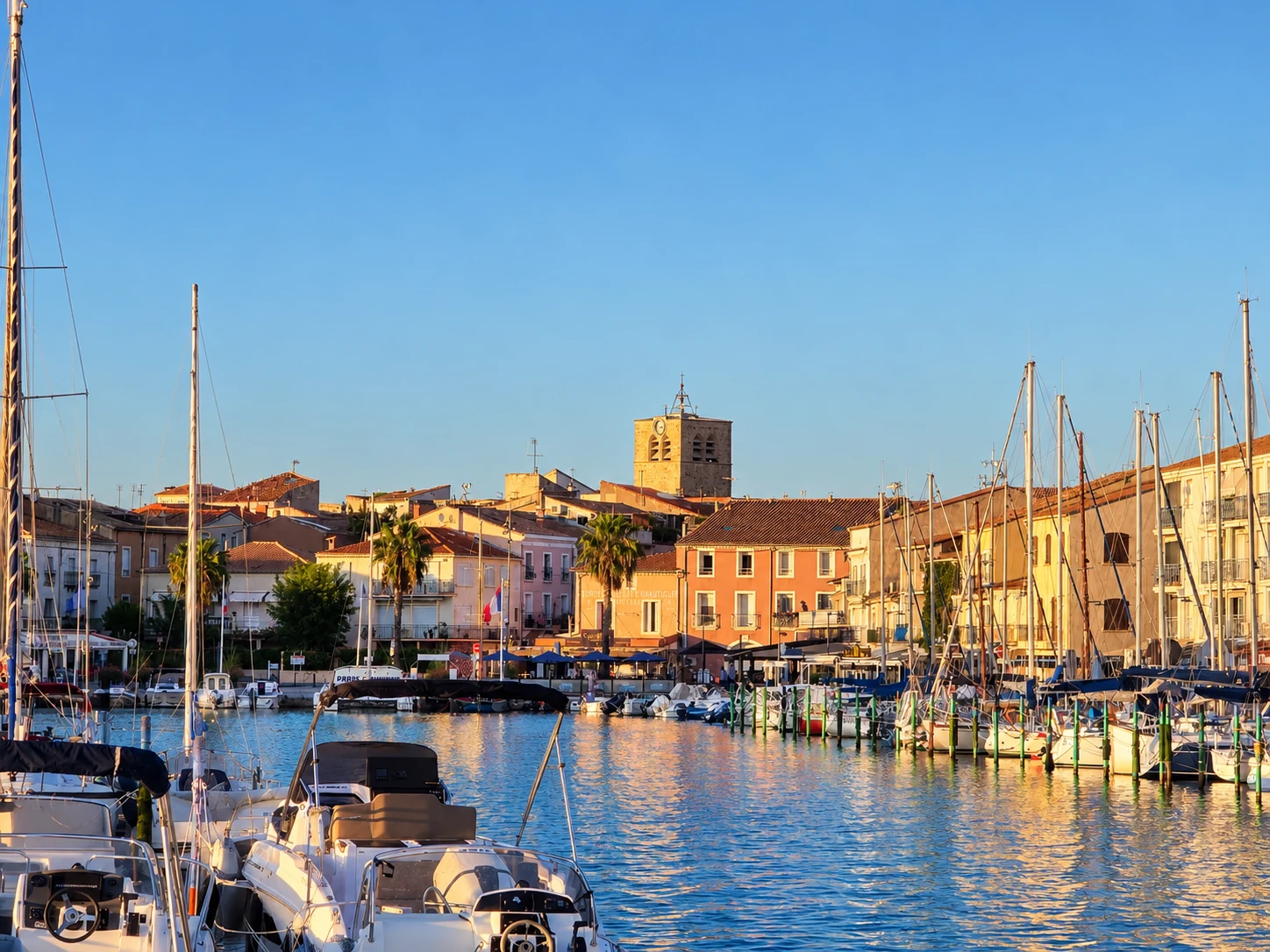
On the shores of the Thau Lagoon, Mèze harbour is one of the town’s must-see places. Lined with restaurants and terraces, it is also the starting point for several activities: boat trips, oyster farm tours on the Thau Lagoon, boat rental and the boat shuttle between Mèze and Sète.
The harbour is easy to explore on foot by walking along its two sides. On Quai Augustin Descournut, the waterfront walk passes the boats, restaurants, the boat maintenance area and the departure point for the Mèze–Sète boat shuttle, before reaching the Thomas-Bessière promenade. On the other side of the harbour, Quai Baptiste Guitard is lined with numerous restaurant terraces and leads to the Mèze Harbour Master’s Office and La Plagette beach.
Mèze harbour is about much more than restaurants and water-based activities. Its history is closely linked to fishing, the wine trade, barrel making and maritime connections with Sète, formerly known as Cette. Several traces of this past can still be seen around the harbour and help visitors understand how it has developed over time.
Today, the harbour is mainly devoted to leisure boating, but it remains both a pleasant place for a walk, a starting point for exploring the Thau Lagoon and a lively part of the town. Its location, right next to the historic centre, means that within just a few minutes you can walk from the quays to the market hall, the town-centre shops or the nearby beaches.
The marina has 197 berths and can accommodate boats up to 15 metres long.
The channel indicated for contacting the Mèze Harbour Master’s Office.
The stated maximum draught for boats entering the harbour.
Quai Augustin Descournut and Quai Baptiste Guitard run around the harbour basin.
Explore both quays, Place Camille Vidal, the Harbour Master’s Office and La Plagette beach. A walk around the harbour basin takes you past the main points of interest without needing a car.
Explore the Thau Lagoon and its oyster farms on a guided boat trip, or rent a boat with or without a licence directly in Mèze.
Restaurants, terraces and waterfront tables line both quays, offering several different atmospheres around the harbour.
See our guide to parking in Mèze to easily reach the harbour, La Plagette beach and the town centre.
Explore Mèze harbour on foot
The best way to discover the harbour is on foot. From the town centre, Rue du Port leads directly to Place Camille Vidal, at the heart of the harbour. From here, it is also easy to walk to the Mèze market hall , located in the heart of the town centre. The walk can then continue along either the right-hand side, following Quai Augustin Descournut, or the left-hand side, along Quai Baptiste Guitard.
This layout makes the harbour particularly easy and enjoyable to explore without following a complicated route. Place Camille Vidal forms the natural connection between the historic centre and the harbour basin. Taking the right-hand side leads towards the leisure boats, the boat maintenance area, the boat shuttle pier and the Thomas-Bessière promenade. Following the left-hand side, you pass the restaurant terraces before reaching the Harbour Master’s Office and then La Plagette beach.
Place Camille Vidal, at the heart of Mèze harbour
Place Camille Vidal, known locally as “Camillet”, is the central point of the harbour. It is named after Camille Vidal (1909–1999), a fisherman from Mèze and French water-jousting champion in 1956 and 1959.
Its position offers a broad view over the harbour basin and makes it easy to choose which direction to take. It is also one of the main crossing points between Rue du Port, the quays and the water-based activities available on the Thau Lagoon.
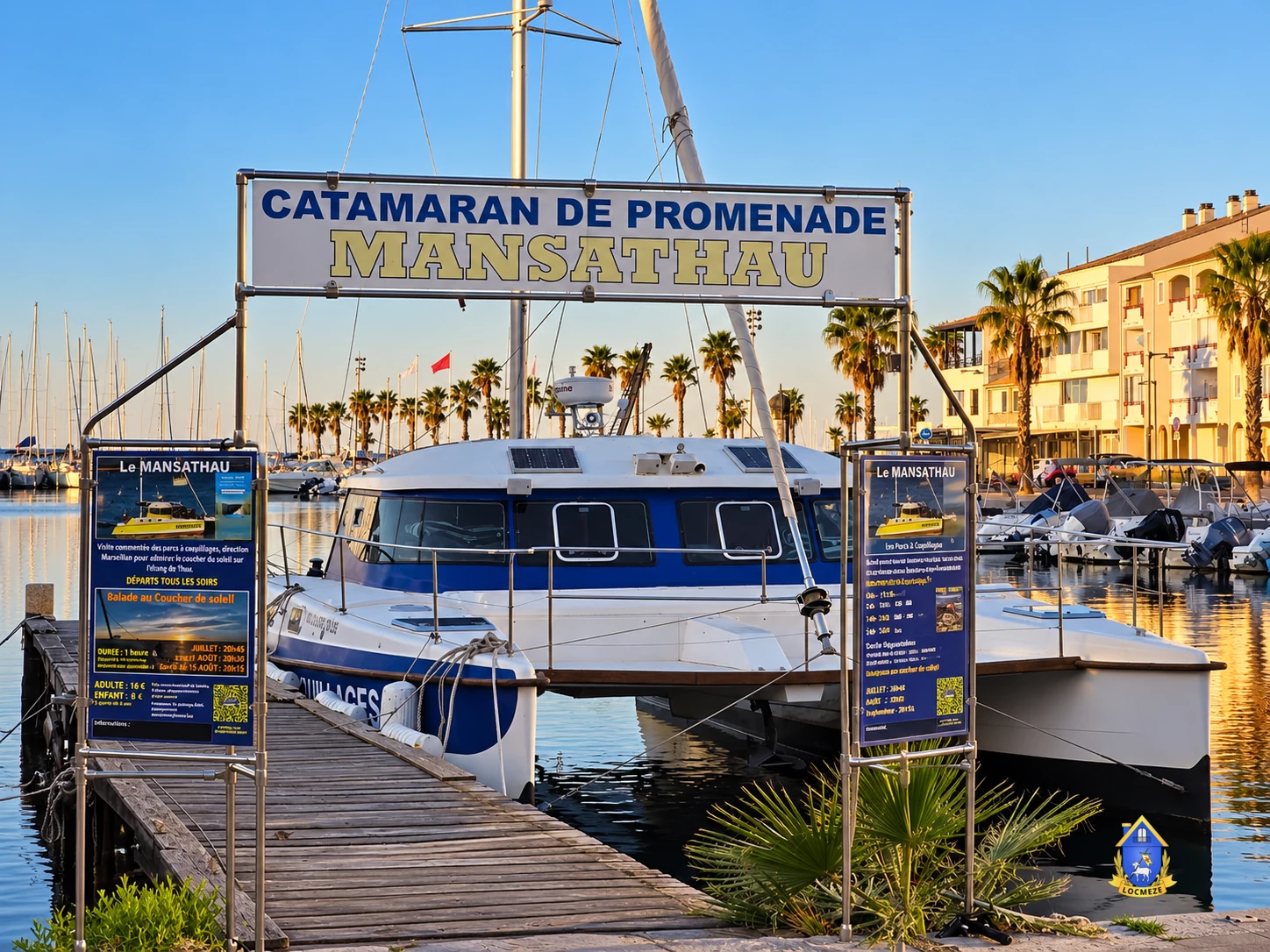
Several activities directly linked to the lagoon also depart from here. Mansathau takes visitors out to discover the shellfish farms, while Midi Plaisance offers boat rental with or without a licence. These activities are covered in more detail in the following sections.
Facing the harbour basin, one building also recalls the harbour’s maritime past: the old inscription “Bureau des bateaux à vapeur” (“Steamship Office”) can still be seen above the building now occupied by Caraïbes Spirit. It dates back to the period when boats regularly operated between Mèze and Cette, the former name of modern-day Sète.
Place Camille Vidal provides easy access to the harbour, restaurants, water-based activities and the town centre. It is therefore a convenient starting point for exploring Mèze harbour before continuing along either quay or into the streets of the historic centre.
Boat trip from Mèze: visit the oyster farms of the Thau Lagoon
From Mèze harbour, you can take a boat trip across the Thau Lagoon to discover its oyster farms and lagoon landscapes. Near Place Camille Vidal, Mansathau offers a guided boat trip focusing on shellfish farming and the history of the lagoon.
During the trip, the boat heads towards the shellfish farms near Bouzigues. The tour explains how oysters and mussels are farmed in the Thau Lagoon, with the long shellfish-farming tables that shape much of the lagoon landscape.
On the return journey to Mèze, the boat passes the shellfish farms established along the shore. This part of the trip offers a closer look at the facilities used by local producers and an activity that is emblematic of the Thau basin, while enjoying the lagoon from the water.
Departing close to Place Camille Vidal makes it easy to combine the boat trip with a walk around the harbour, its quays and terraces, without having to use the car again.
What can you see on a boat trip across the Thau Lagoon?
The trip offered by Mansathau lasts approximately 55 minutes. After introducing the geography of the Thau Lagoon, the captain explains the history of shellfish farming and the methods used today to produce oysters and mussels.
The trip gives visitors a chance to see the shellfish farms directly from the water and better understand the role of the many farming tables that occupy part of the lagoon. Seeing them from the boat provides a very different view of the landscape from the one seen from the quays or the roads around the lagoon.
When weather conditions allow, part of the trip may also be made under sail. The route then offers views across several landscapes of the Thau basin: Bouzigues, Balaruc-les-Bains, Sète, Mont Saint-Clair and the lido , as well as Cap d’Agde and Mont Saint-Loup, before returning towards the Mèze waterfront.
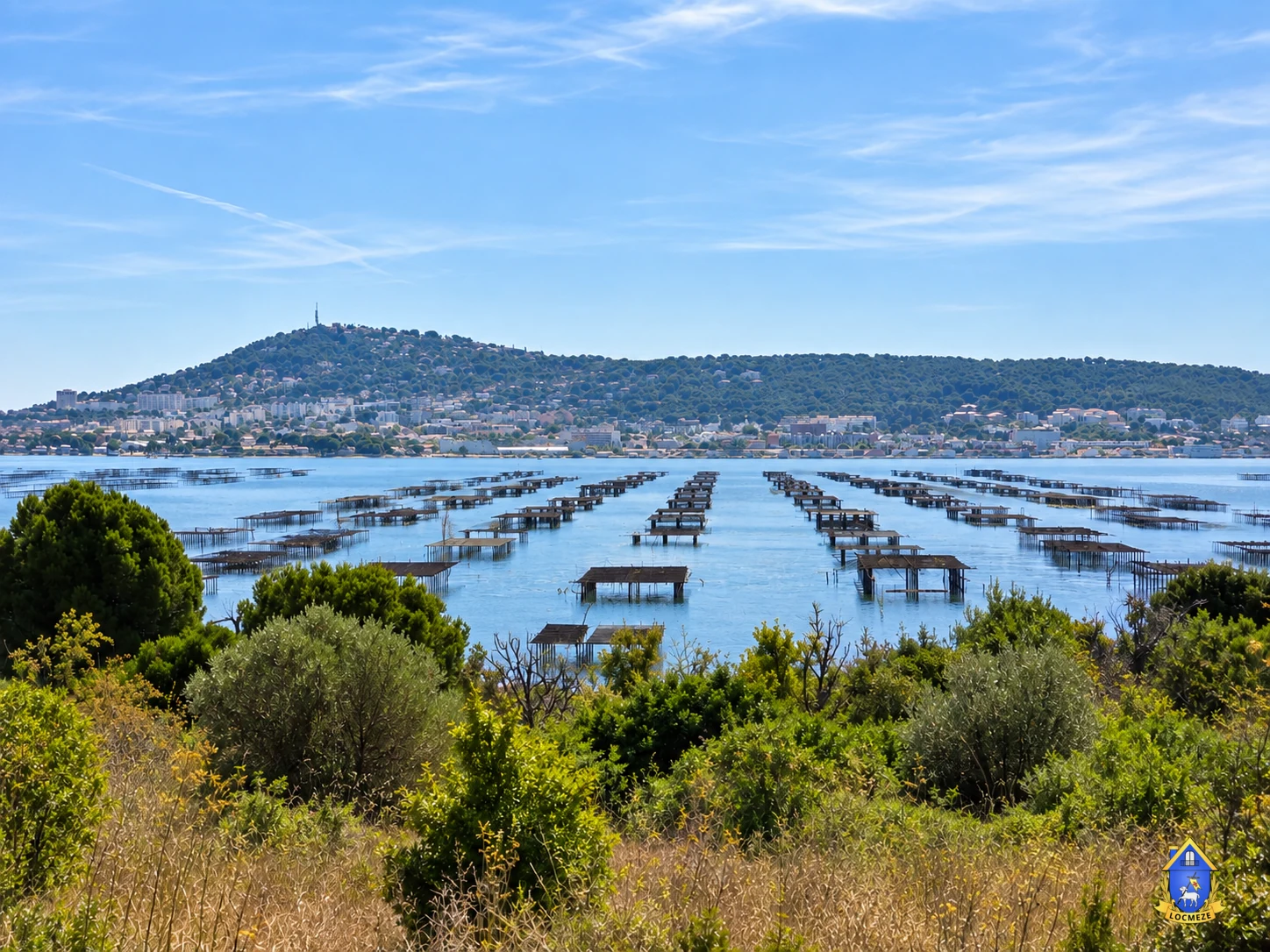
How are oysters farmed in the Thau Lagoon?
Unlike oysters farmed on tidal coastlines, those of the Thau Lagoon grow in a lagoon where tidal movement is very limited. Producers therefore use a specific farming technique: the shellfish are suspended beneath large shellfish-farming tables installed in the lagoon.
The traditional technique notably uses suspended ropes attached to these tables. Oysters are fixed to the ropes and remain submerged while they grow. This deep-water farming method, developed during the 20th century, is characteristic of Mediterranean shellfish farming.
Today, the lagoon contains approximately 2,600 shellfish-farming tables, spread across the areas of Bouzigues-Loupian, Mèze and Marseillan. From the boat, their geometric layout is particularly visible and shows just how important this activity is to the lagoon landscape.
Mèze plays an important role in this economy. Mourre Blanc, located outside the marina, is the town’s main shellfish-farming area and is described by the Town of Mèze as the largest shellfish-farming harbour in the Mediterranean. Oyster and mussel production therefore remains deeply connected to the local identity and economy.
A boat trip through the oyster farms therefore reveals another side of Mèze beyond its marina: the traditional occupations of the lagoon and the “farmers of the sea”, whose work has shaped the landscape of the Thau basin for generations.
Boat rental in Mèze: with or without a licence
To explore the Thau Lagoon at your own pace, you can also rent a boat in Mèze directly from the harbour. Midi Plaisance offers boats that can be hired with or without a licence, allowing you to explore the lagoon independently.
Hiring a boat without a licence is a simple option for a first trip on the lagoon, while visitors with a boating licence can choose a boat suited to more independent navigation. From Mèze, the lagoon offers a large area to explore between the different harbours and landscapes of the Thau basin.
Midi Plaisance also operates a boating school where visitors can prepare for and take different boating licences, including the coastal boating licence and the inland waterways licence.
Between Mansathau’s guided trips and the boat rentals with or without a licence offered by Midi Plaisance, Mèze harbour is therefore a particularly convenient starting point for discovering the Thau Lagoon from the water, whether you prefer a guided excursion or exploring independently.
The guided boat trip introduces visitors to the shellfish farms and the history of the lagoon through the captain’s commentary.
Boat rental with or without a licence provides greater freedom to explore the Thau Lagoon from Mèze harbour.
Plan a boat trip from Mèze
To plan a trip from Mèze harbour or an excursion on the Thau Lagoon and along the Mediterranean coast, BoatMap can be a useful tool for boaters. The app includes nautical charts, marine weather forecasts, information about harbours and anchorages, as well as route-planning and GPS tracking features.
It also provides information about services available in different harbours and helps boaters check sailing conditions before setting off. Charts can be downloaded for offline use, which can be useful when mobile coverage becomes weaker at sea. BoatMap covers the French Mediterranean coast and can be used for both coastal trips and longer journeys.
The right-hand side of Mèze harbour: Quai Augustin Descournut
From Place Camille Vidal, the walk can continue along the right-hand side via Quai Augustin Descournut. This part of the harbour combines terraces, restaurants, shops and boating activities, with boats moored all along the basin.
At the beginning of the quay, several establishments line the harbour, including Café du Port, Le Parc, L’Envie est Belle and Le 29. Further along, terraces and shops keep the waterfront lively before the walk reaches an area closely associated with Mèze’s nautical traditions.
The right-hand side is particularly closely linked to traditional Languedoc water jousting, a tradition deeply rooted in local life. The boats used during competitions can often be seen here. During the jousting season, the harbour basin becomes a spectacular competition arena.
Traditional Languedoc water jousting in Mèze harbour
Water jousting occupies a special place in the history and traditions of Mèze. Competitions take place directly in the harbour basin: two boats pass one another while the jousters, standing on raised platforms known as tintaines, try to knock their opponent into the water using a lance and shield.
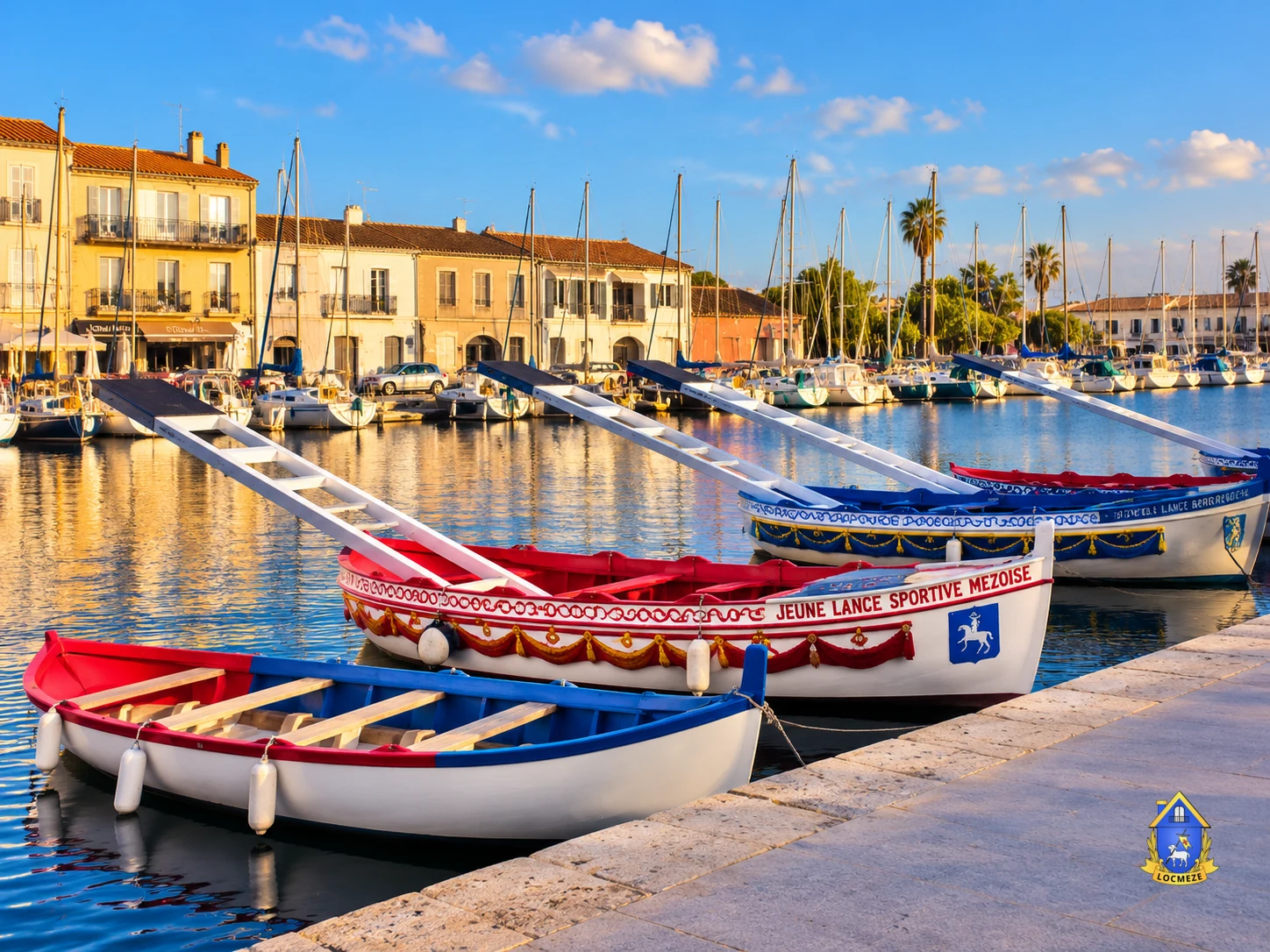
On competition days, stands are installed along the quay and the harbour takes on a completely different atmosphere. Several age categories may compete throughout the season, from younger competitors to adult categories.
During the Mèze festivities , the harbour also hosts another spectacular local tradition: Lou Capelet, also known as the greasy pole race. Participants attempt to walk along a long, heavily greased pole positioned above the water to reach a hat placed at the end. Falling into the harbour basin is naturally part of the spectacle.
Between the water-jousting tournaments and the Capelet festivities, the harbour basin remains an important gathering place for local residents. These popular events preserve traditions closely linked to the Thau Lagoon and bring a distinctive atmosphere to the harbour during the summer season.
The boat maintenance area: a working harbour
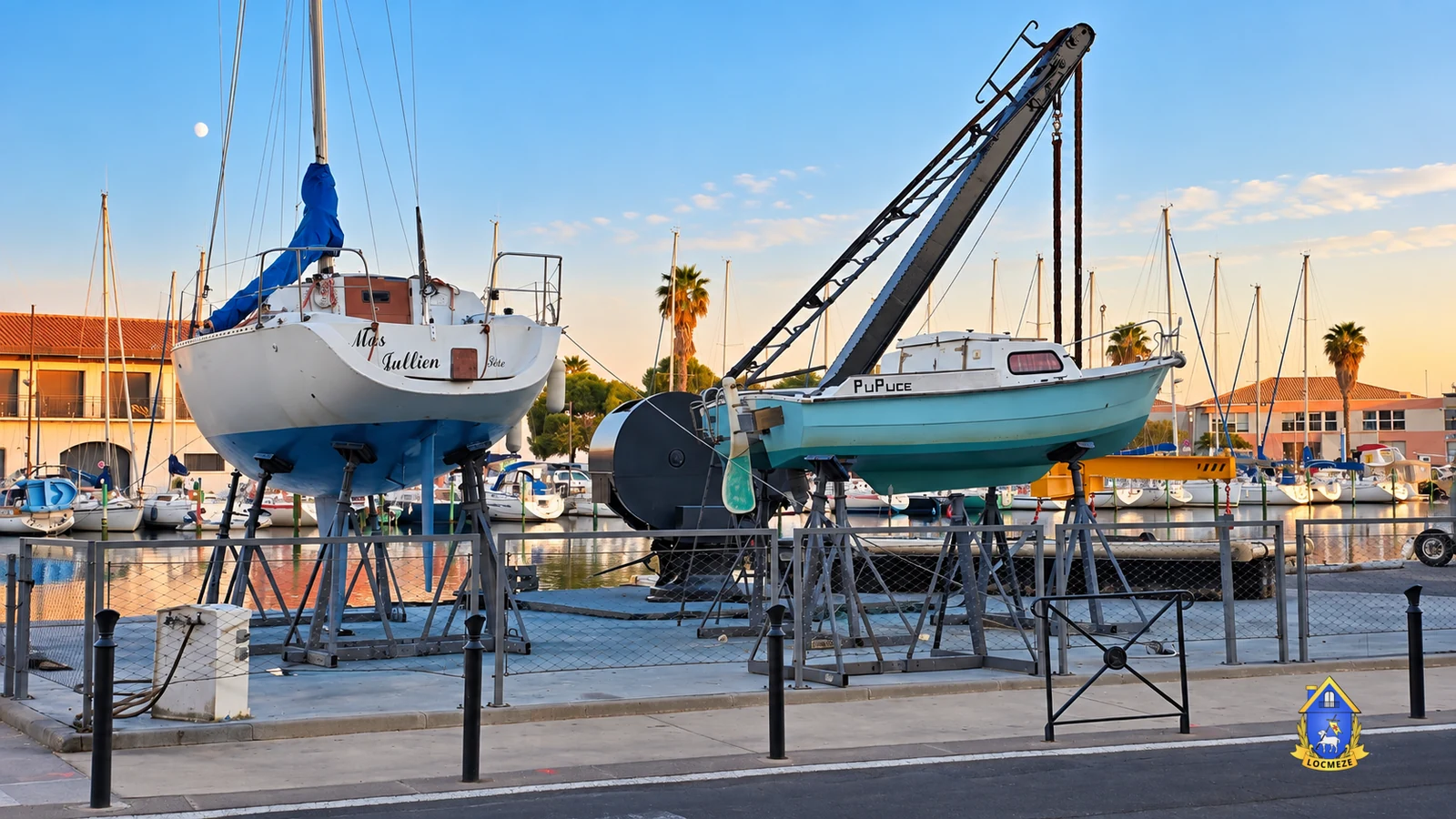
Continuing along Quai Augustin Descournut, you reach the boat maintenance area. Boats lifted out of the water and resting on cradles, together with the handling equipment, are a reminder that Mèze harbour is not only a place for walking and leisure boating: it is also a working nautical area.
This area reveals a more technical side of the harbour, used particularly for boat maintenance and lifting vessels out of the water. It also gradually marks the transition between the busiest part of the quay, lined with restaurants, and the boat shuttle area followed by the Thomas-Bessière promenade.
The Mèze–Sète boat shuttle from the harbour
After passing the boat maintenance area and the last restaurants along the quay, including L’Abri Côtier, you reach the departure point for the Mèze–Sète boat shuttle, located beside the harbour basin.
This boat service provides a direct connection to Sète from Mèze harbour, crossing the Thau Lagoon. It is a pleasant alternative to travelling by car and provides an opportunity to see the lagoon from the water while connecting two of its main towns.
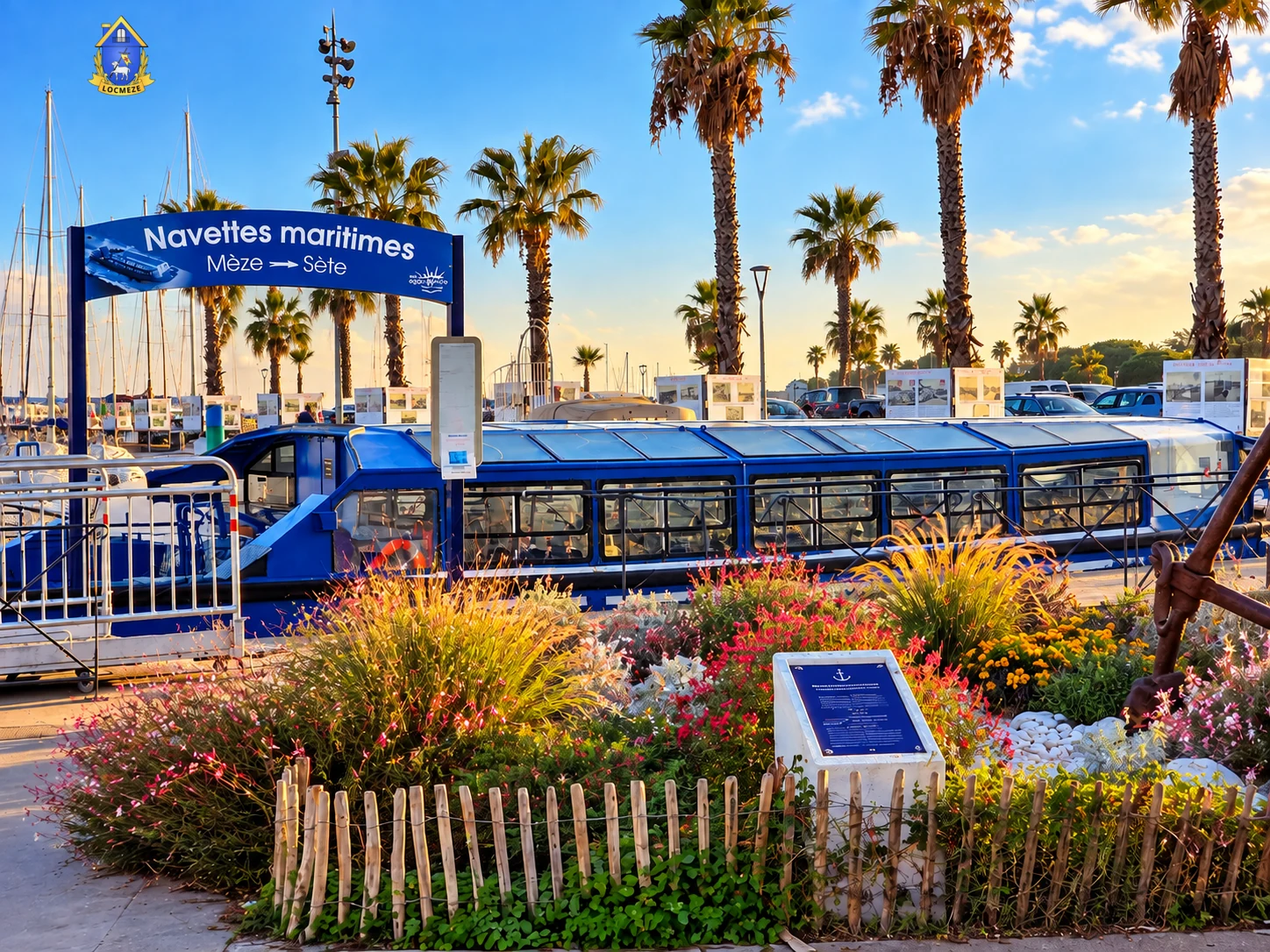
The shuttle operates seasonally. As operating dates, timetables and frequency may change from one year to another, it is best to check the latest information before travelling.
Today’s shuttle service is also part of a long history of maritime connections between the two towns. Long before today’s boats, steamships already crossed between Mèze and Cette, the former name of Sète, carrying passengers and goods from one side of the lagoon to the other. This history is explored in greater detail later in the section devoted to the development of the harbour.
Thomas-Bessière promenade and Place des Tonneliers
Continuing beyond the shuttle pier, you reach Place des Tonneliers and then the Thomas-Bessière promenade. This part of the harbour has a different atmosphere from the restaurant-lined quays: the space opens out towards the basin and is particularly pleasant for a walk beside the water.
Several secure pontoons provide access to the boats moored in this part of the harbour. The promenade also features information panels about the history of Mèze and its harbour, helping visitors understand the development of the area, fishing and former maritime activities.
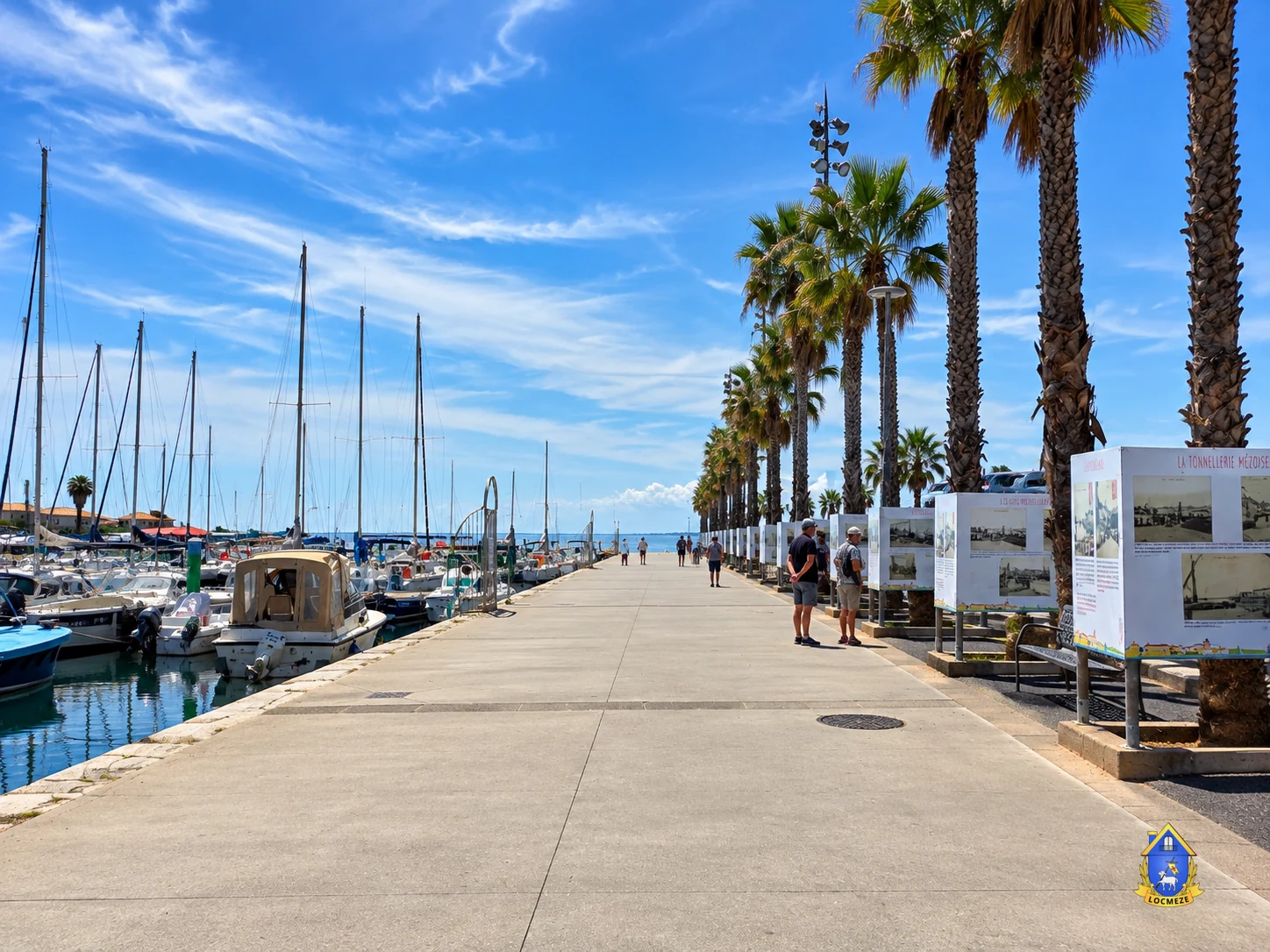
The Thomas-Bessière promenade also hosts the Mondial de l’Huître de Mèze, an event dedicated to oysters from the Thau Lagoon and local gastronomy. The event brings a special atmosphere to the waterfront and provides an opportunity to discover dishes and creations based around this emblematic product of the Thau basin. To find out more, see our article about the Mondial de l’Huître de Mèze .
On the town side, Parking des Tonneliers provides parking close to the Thomas-Bessière promenade and easy pedestrian access to this part of the harbour. It is a convenient starting point for exploring the pontoons, boats and waterfront without having to move your car.
To plan your visit and locate other parking options around the harbour basin and town centre, see our guide to parking in Mèze .
At the far end of Parking des Tonneliers, you gradually leave the harbour area. The walk can nevertheless continue towards Le Baphin and then Taurus beach, located further along the Thau Lagoon. To explore the other side of the harbour, simply return to Place Camille Vidal, where the route along Quai Baptiste Guitard begins.
The left-hand side of Mèze harbour: Quai Baptiste Guitard
From Place Camille Vidal, the walk can also continue along the left-hand side via Quai Baptiste Guitard. This part of the harbour is particularly lively thanks to the restaurants and terraces overlooking the boats.
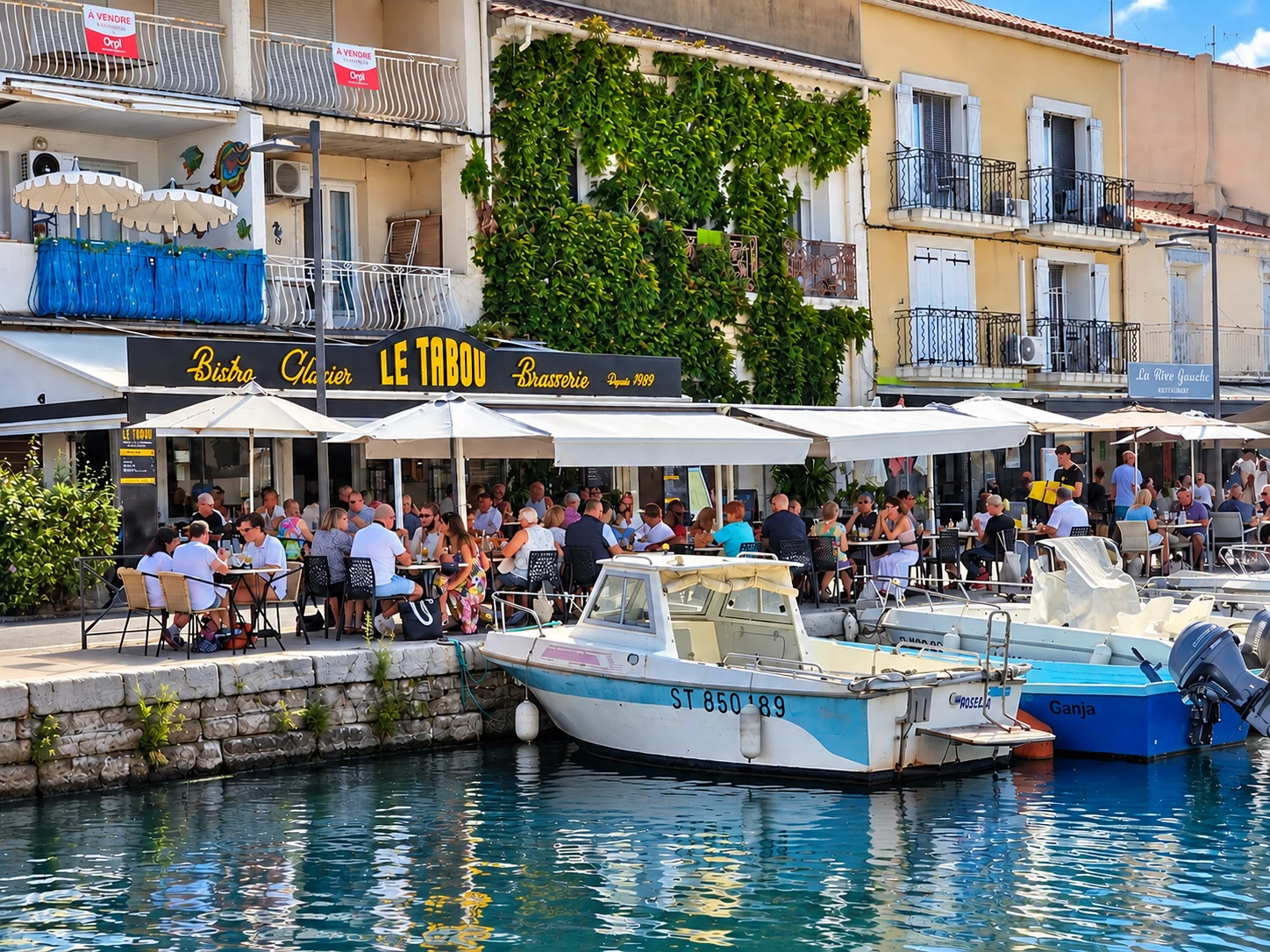
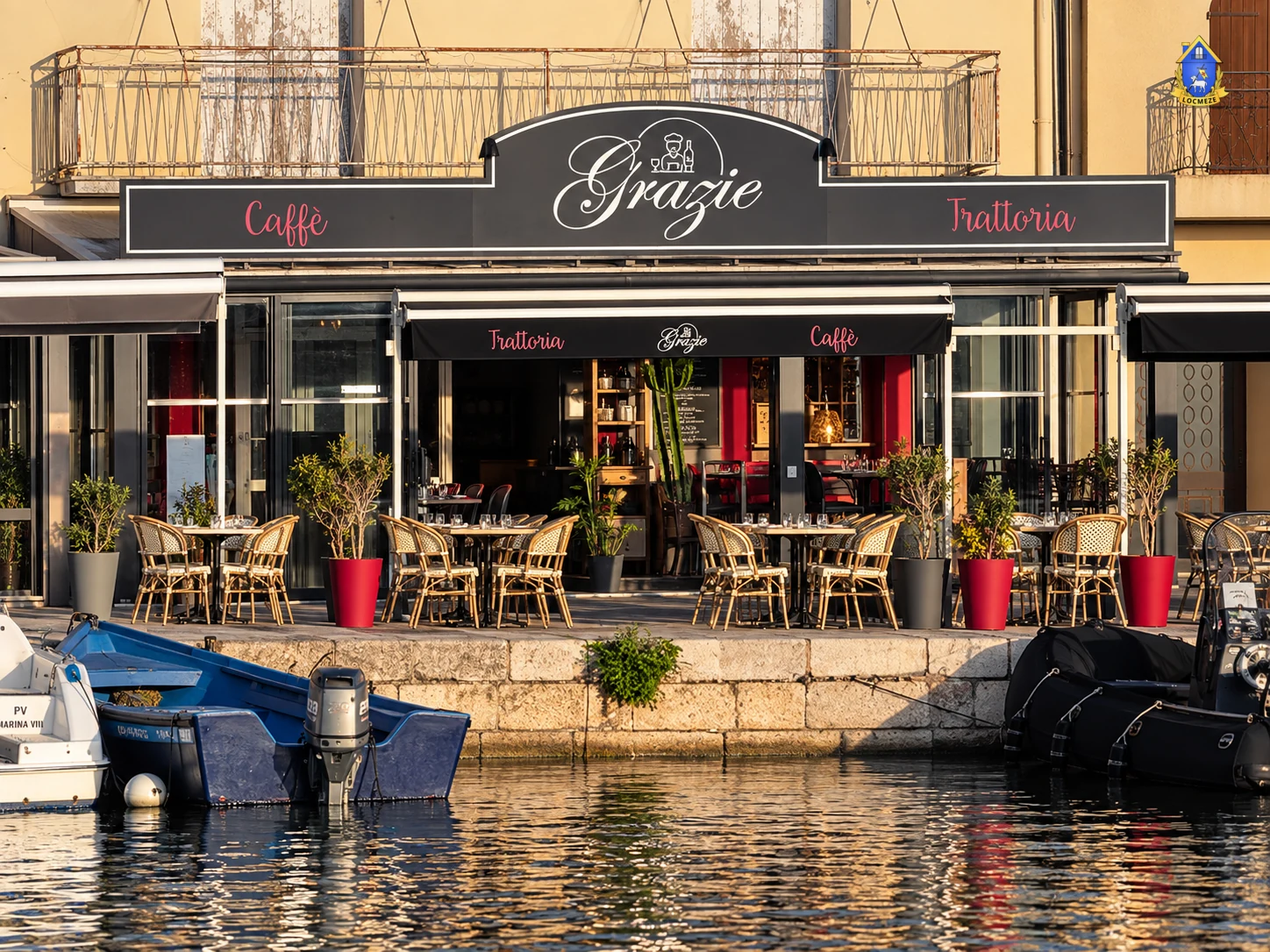
At the beginning of the quay, you first pass Le Pirate, followed by Le Bistrot del Mar, before continuing past several other establishments including Le Tabou and Grazie. This concentration of restaurants makes the left-hand side one of the liveliest parts of the harbour, particularly in fine weather when the terraces face the basin.
We look at several of these establishments in more detail in the section devoted to restaurants around Mèze harbour.
Rue Privat: direct access to La Plagette beach
Further along Quai Baptiste Guitard, Rue Privat branches off to the left and provides quick access to La Plagette beach . This short connection is useful if you want to extend your harbour walk along the edge of the lagoon or take a break on the beach.
If you remain on Quai Baptiste Guitard rather than turning into Rue Privat, the walk continues past the final restaurants on this side of the harbour. The terraces gradually become fewer, while moored boats and residential buildings become more prominent in the landscape.
The route becomes quieter as you move away from Place Camille Vidal and approach the premises of the Nouvelle Lance Mézoise.
Nouvelle Lance Mézoise and the water-jousting tradition
A little further along are the premises of the Nouvelle Lance Mézoise, one of the town’s water-jousting associations. The building is used by the association and reflects the importance of traditional Languedoc water jousting in the identity of Mèze harbour.
A panel on the building recounts the history of this tradition. It explains in particular that Mèze has two water-jousting associations: the Jeune Lance Sportive Mézoise, founded in 1945, and the Nouvelle Lance Mézoise, founded in 1981.
After the Nouvelle Lance Mézoise premises, the walk continues to the end of the quay. The Harbour Master’s Office car park is on the left, while the boats remain on the right. You then reach the Harbour Master’s Office, located only a few dozen metres from La Plagette beach.
Here, the harbour lies on one side and the beach on the other, making it easy to continue your visit along the shore of the Thau Lagoon. This end of the quay effectively marks the transition between the harbour basin and the La Plagette area.
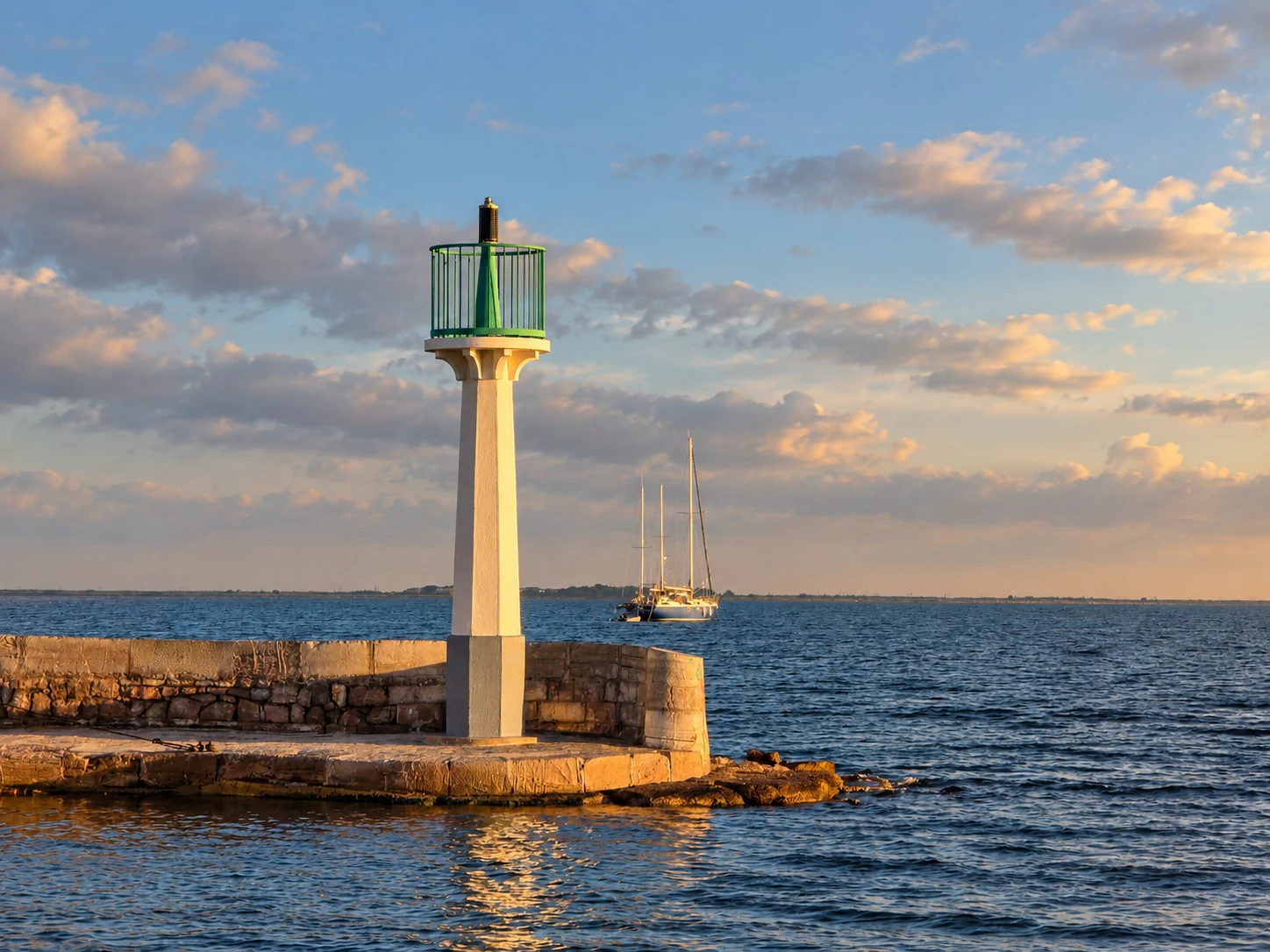
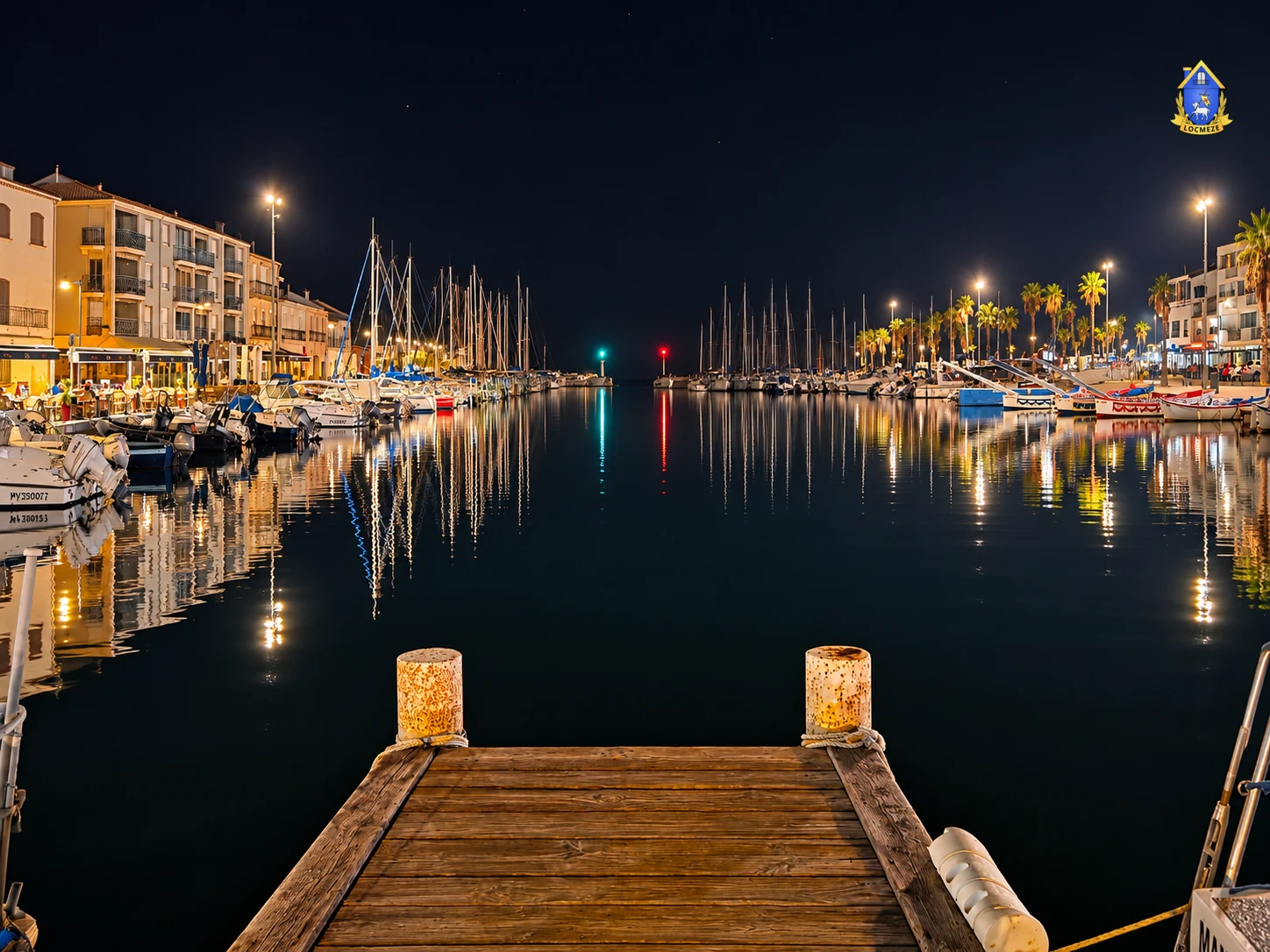
The harbour wall also marks the entrance to the basin, where green and red navigation lights guide boats. These lights mark the passage between the sheltered Mèze harbour and the more open waters of the Thau Lagoon.
Mèze Harbour Master’s Office: access, opening hours and services
After the Nouvelle Lance Mézoise premises, continue to the end of Quai Baptiste Guitard. The Harbour Master’s Office car park is on the left, with the boats on the right. You then reach the Mèze Harbour Master’s Office, located in the Maison de la Mer, only a few dozen metres from La Plagette beach.
The Harbour Master’s Office manages the harbour and its boat berths. Applications for annual berths and seasonal moorings are handled by the harbour service.
Harbour Master’s Office opening hours in 2026
Harbour office opening hours vary according to the season. The opening hours published for 2026 are divided into three main periods.
Weekend opening hours also vary depending on the period. It is therefore advisable to check the latest information on the official Town of Mèze website before visiting, particularly for enquiries relating to a berth or visiting boat.
For visitors exploring on foot, the Harbour Master’s Office is also an excellent landmark for understanding the layout of the harbour: the basin and boats are on one side, while La Plagette beach lies on the other. It takes only a few steps to reach the beach and continue walking along the shore of the Thau Lagoon.
The area also has the Harbour Master’s Office car park , which is convenient for reaching this end of the harbour, the Maison de la Mer and La Plagette beach.
From Place Camille Vidal, simply follow Quai Baptiste Guitard all the way to the end to reach the Harbour Master’s Office. The route passes the restaurants, boats, the Nouvelle Lance Mézoise premises and the Harbour Master’s Office car park, before arriving almost directly at La Plagette beach.
Restaurants at Mèze harbour: where to eat
The harbour is one of the most enjoyable areas for finding a restaurant in Mèze. Both sides of the basin are lined with restaurant terraces overlooking the boats, creating a particularly lively atmosphere in fine weather and in the evening.
Restaurants are mainly located along Quai Augustin Descournut, on the right-hand side, and Quai Baptiste Guitard, on the left-hand side. Both areas are easily reached on foot from Place Camille Vidal.
Among the various places around the harbour, here are several restaurants we particularly enjoy and which offer the opportunity to experience the atmosphere of the waterfront.
L’Abri Côtier on the right-hand side
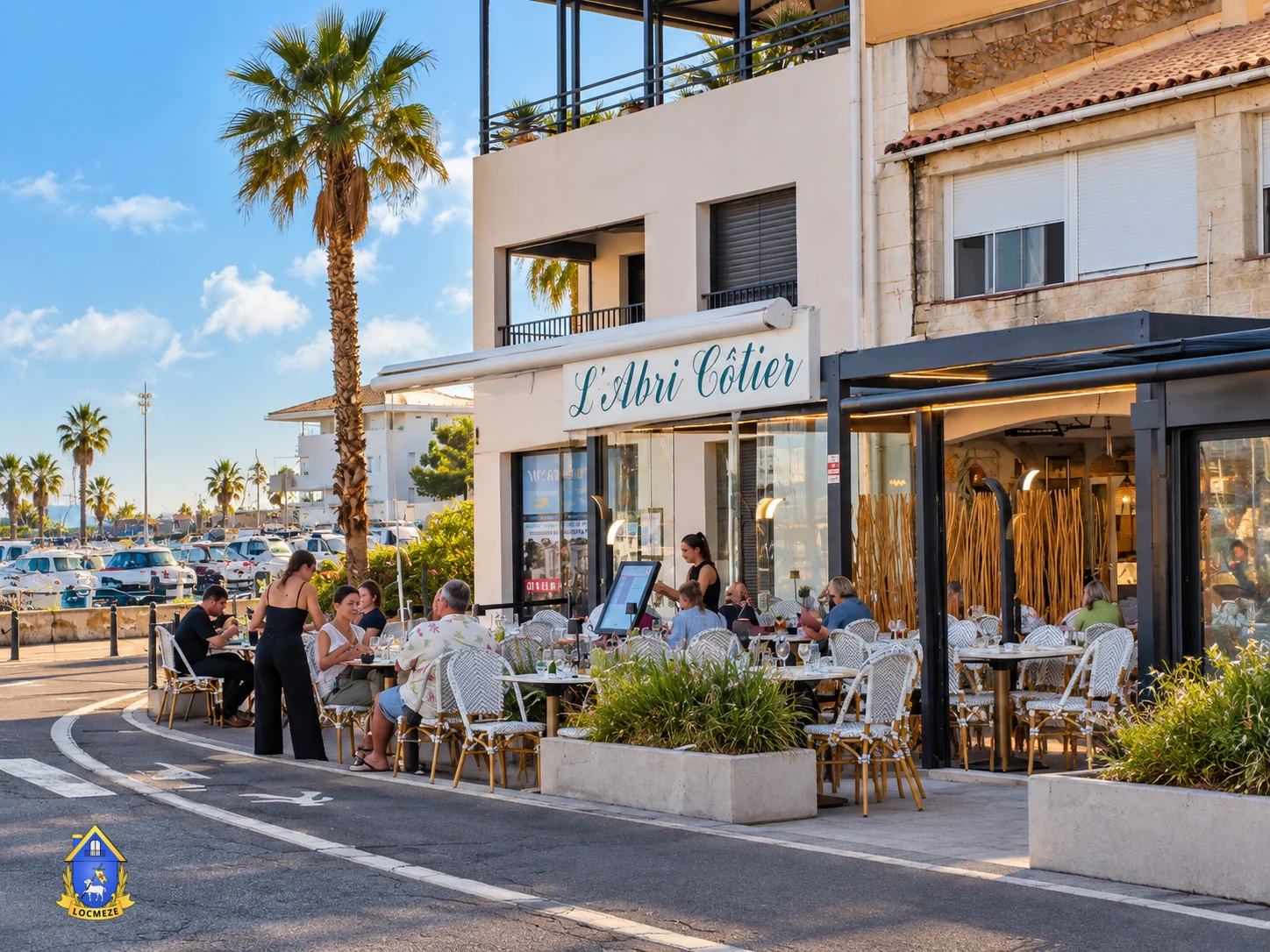
On Quai Augustin Descournut, L’Abri Côtier is located at number 28, towards the end of the restaurant-lined section of the quay. Its terrace overlooks the harbour and passing boats, close to the departure point for the Mèze–Sète boat shuttle.
Le Bistrot del Mar
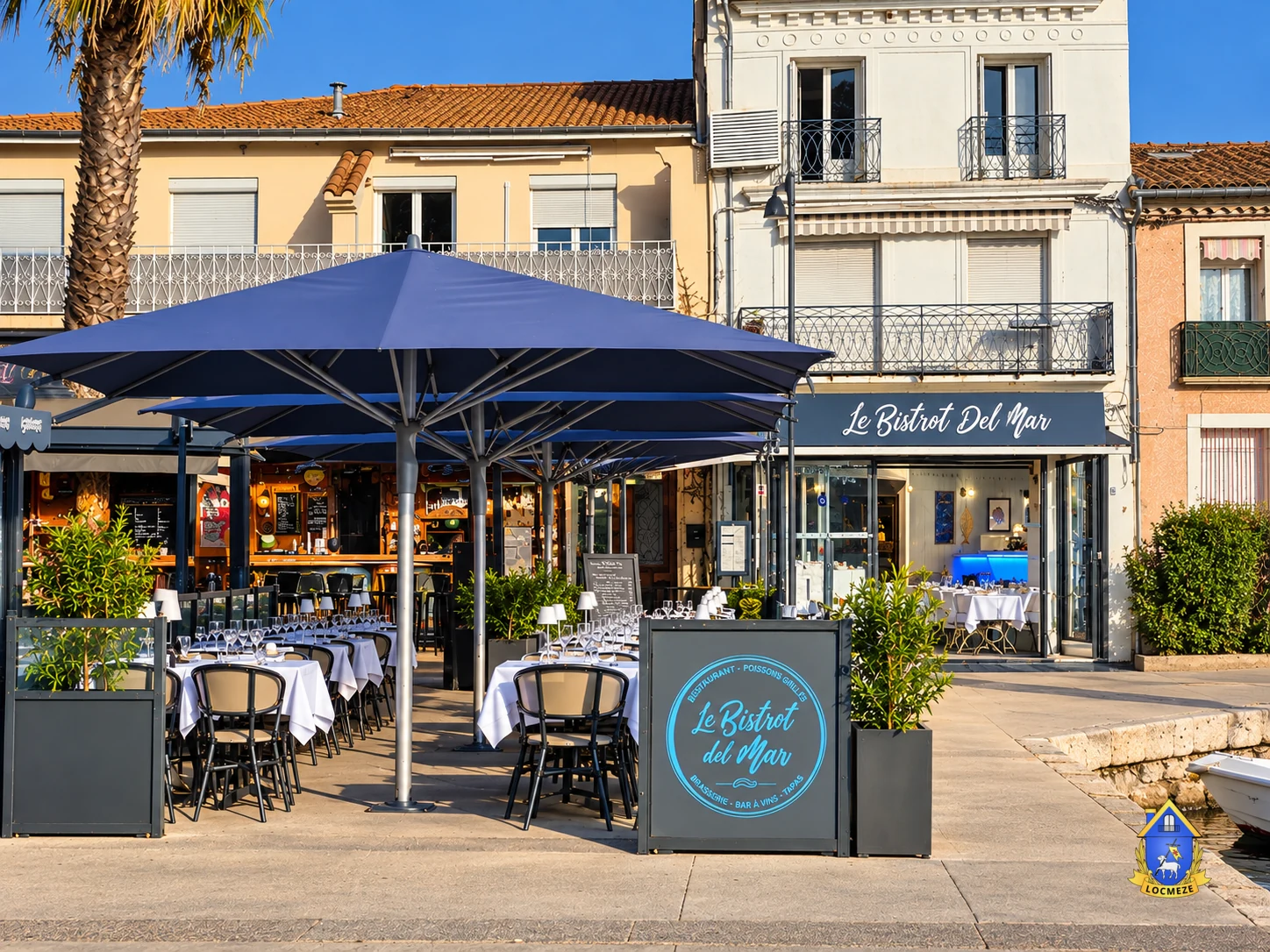
On the left-hand side, Le Bistrot del Mar, located at number 5 Quai Baptiste Guitard, is one of the first terraces you come across when arriving from Place Camille Vidal.
Le Tabou
A few metres further along, Le Tabou, located at number 9 Quai Baptiste Guitard, is another place to enjoy lunch or dinner overlooking the harbour basin and the moored boats.
Grazie
Also on Quai Baptiste Guitard, Grazie, at number 15, is one of the restaurants located directly opposite the harbour. It is only a few minutes’ walk from Bistrot del Mar and Le Tabou.
The left-hand side has several restaurants within a short distance of one another, while the right-hand side combines terraces, boating activities and waterfront walks. On either side, it is easy to explore the quays on foot before or after your meal.
History of Mèze harbour: from the Middle Ages to today
The harbour we see today is the result of several centuries of transformation. Its location on the shores of the Thau Lagoon encouraged trade, fishing and the transport of goods from an early period.
Over time, the harbour basin expanded and its activities evolved with the development of the wine trade, barrel making, steam navigation and later shellfish farming.
The quays we walk along today still preserve traces of these different periods: old signs, buildings, street names, heritage panels and historic photographs help tell part of Mèze’s maritime history.
A harbour developed from the Middle Ages
During the Middle Ages, Mèze was surrounded by defensive walls built between the 12th and 13th centuries. One of the four gates in these fortifications provided direct access to the harbour.
At that time, the walls extended almost as far as the lagoon and the harbour looked very different from the one we know today, with only two breakwaters that have since disappeared.
Harbour activity gradually developed from the 14th century, with goods from the surrounding region passing through Mèze. The lagoon was then an important transport route, often considered safer than travelling by sea.
The harbour was significantly developed in 1702, although silting of the basin continued to make its development difficult for many years. Growing trade and increasing traffic gradually led to further work and several expansions.
1866: Mèze harbour doubles in size
In 1866, the surface area of the harbour was doubled. The town reclaimed land from the lagoon and reorganised the entire area around the basin.
New facilities and buildings gradually appeared near the harbour: warehouses, a distillery, a slaughterhouse and a washhouse . These changes accompanied Mèze’s economic development and prepared the harbour for a particularly active period in the late 19th and early 20th centuries.
This expansion came at a time when the quays were playing an increasingly important role in Mèze’s trade. Goods transport, the wine trade and barrel making were major harbour activities.
The wine trade and barrel making: driving forces behind the harbour
In the late 19th and early 20th centuries, Mèze harbour experienced a period of intense activity linked to the wine trade, distilling and barrel making .
The quays were used for loading and unloading many different goods, particularly barrels used to transport wine.
Barrel making played an important role in the local economy. In 1905, Établissements Alexandre Bézard operated a barrel-making factory in Mèze.
Barrels and large wine casks were everywhere on the quays, regularly taking up much of the space around the harbour basin.
The activity became so important that the Quai du Nord, now known as Quai Augustin Descournut, was widened in 1875. The extra space was quickly taken up by increased traffic and the needs of merchants, wine traders and barrel makers.
Historic photographs of the harbour show boats loaded with barrels ready to travel to Cette, now known as Sète. Some boats could carry several dozen large casks of approximately 500 to 650 litres.
Sailing boats and fishing on the Thau Lagoon
Long before motorboats became widespread, the harbour was filled with numerous sailing boats. These included catalanes, traditional boats used in particular for transporting goods, as well as flat-bottomed fishing boats suited to navigating the lagoon.
Fishing provided a living for many families in Mèze. Sea bream, eels, European seabass, mullet and shellfish were among the resources traditionally harvested from the Thau Lagoon.
At the beginning of the 20th century, fish were still sold directly beside the harbour. Historic documents show the fish market on Rue du Port, where catches were laid out on hessian cloth before being sold.
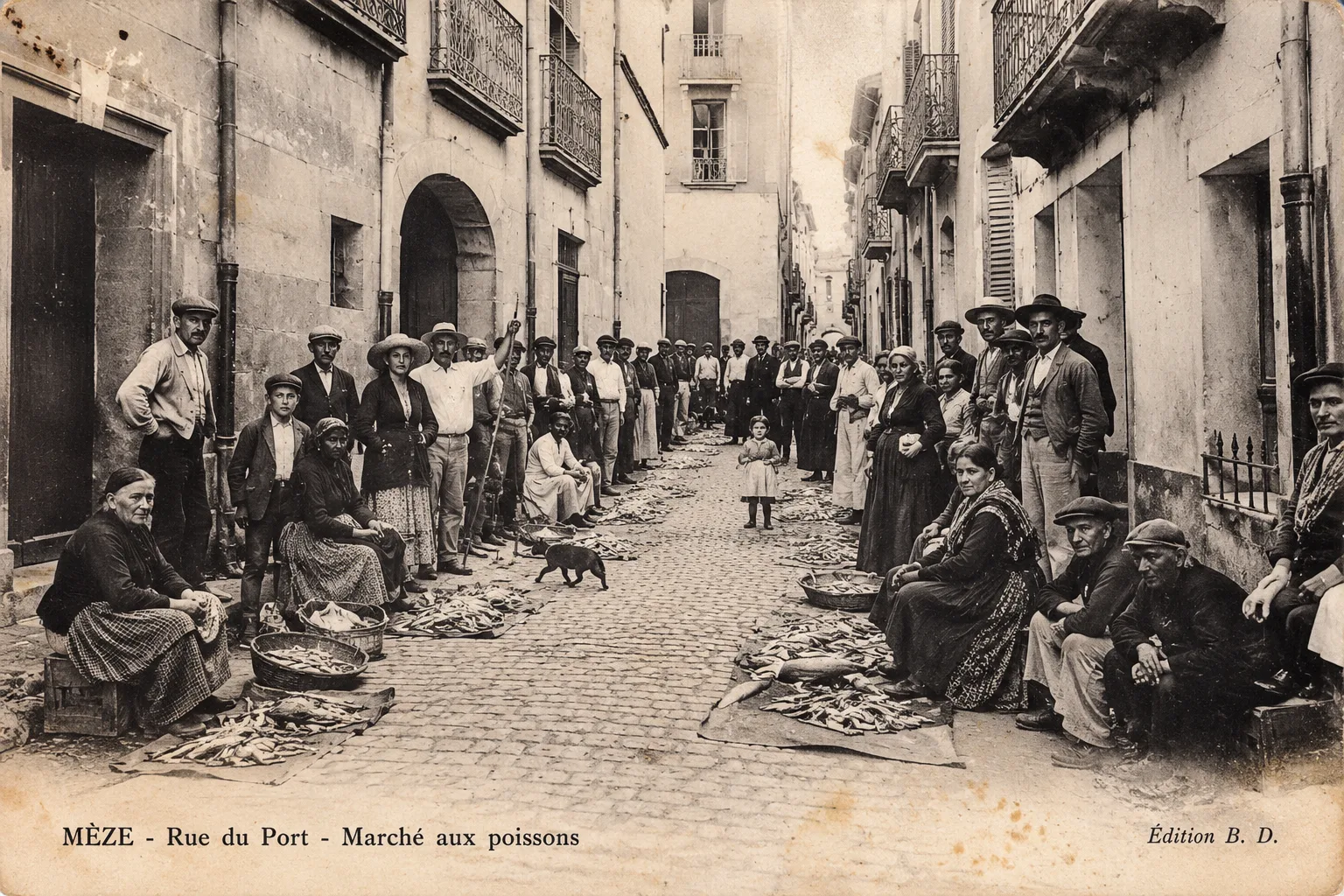
These market scenes show just how important fishing was to the daily life of the harbour and its residents. But the harbour basin also welcomed goods and passengers.
In the late 19th century, the development of regular services to Cette, particularly by steamship, brought a new dimension to maritime activity in Mèze.
Steamships between Mèze and Cette
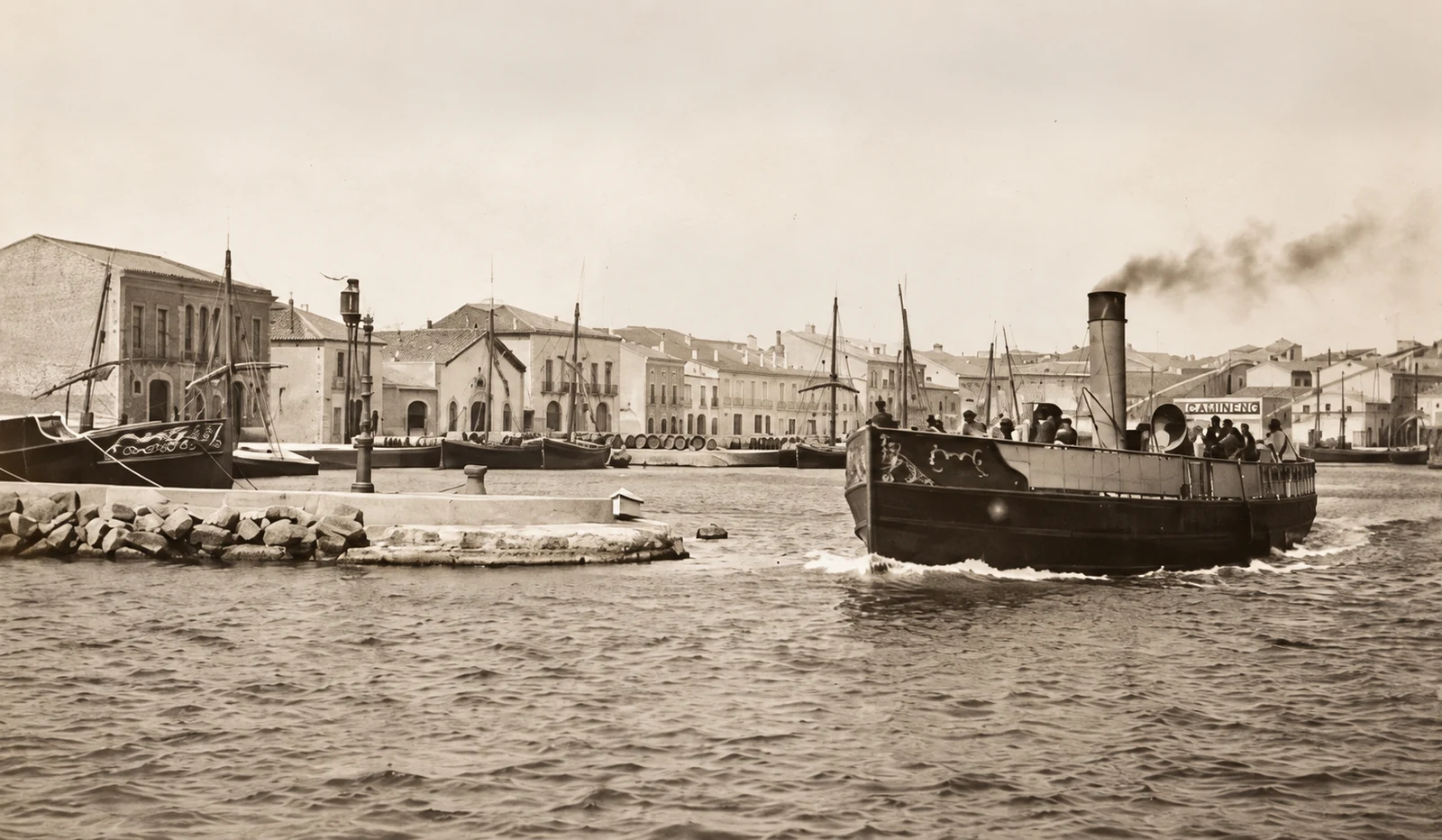
From the late 19th century onwards, regular connections between Mèze and Cette developed significantly with the arrival of steamships.
The Société Maritime de Mèze, founded in 1891, operated several vessels crossing the lagoon. These included L’Esclop, l’Ancien Courrier and le Nouveau Courrier.
At the time, the Mèze–Cette service operated several times a day, carrying both passengers and goods. The quays became very busy points of arrival and departure.
This activity also explains why the old inscription “Bureau des bateaux à vapeur” (“Steamship Office”) can still be seen today on a building near Place Camille Vidal.
Harbour cafés and social life around the quays
Around the beginning of the 20th century, harbour cafés played an important role in the everyday life of Mèze. They were meeting places for fishermen, agricultural workers, barrel makers, travellers and local residents.
Before the First World War, these establishments were still often known as estaminets. Cafés were therefore as much a part of harbour life as the shops, warehouses and landing stages.
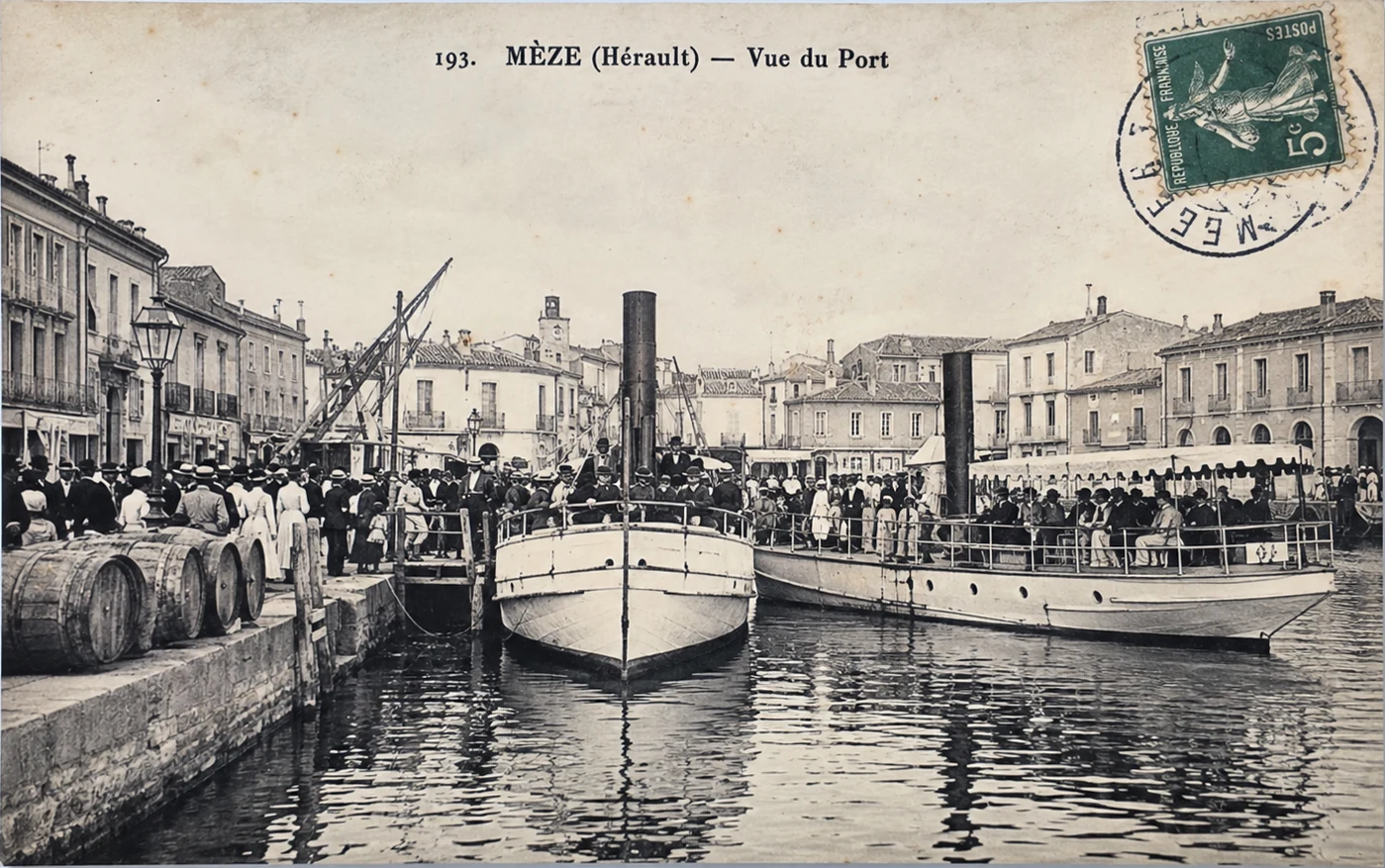
One of the best-known establishments was the Café des Bateaux à Vapeur, particularly frequented by travellers waiting for departures to Cette.
Another establishment, the Café du Port, also stood on the quay and contributed to the lively atmosphere of the area.
Drinking habits were also very different from today. After a meal, some customers would, for example, order a champoreau, a mixture of coffee and liqueur, or a mazagran, strong coffee served cold with lemon and sometimes rum.
Cafés at the time were overwhelmingly frequented by men. At the beginning of the 20th century, however, Mèze also had establishments aimed mainly at women, known as “cafés d’un sou”.
From maritime transport to competition from coaches
From the 1930s onwards, boat services gradually began to lose importance as road transport developed. Several coach companies began competing directly with crossings of the lagoon.
The Société Maritime de Mèze ceased operating a few years later. One boat, Le Samos, operated by Louis Lacombe, nevertheless continued carrying passengers across the lagoon until 1951.
This period marked the gradual end of a form of transport that had shaped harbour life for several decades.
From fishing to shellfish farming
After the Second World War, harbour activity changed once again. Fishing remained important, but shellfish farming gradually became increasingly significant around the Thau Lagoon.
Around the middle of the 20th century, the first facilities used for shellfish farming began to develop across the lagoon. Historic documents show the installation of structures that would later support the shellfish-farming tables.
This transformation marked a new stage in the economic history of Mèze. Oysters and mussels gradually became some of the strongest symbols of the Thau basin, while harbour activities increasingly shifted towards leisure boating, waterfront walks and water-based activities.
Mèze harbour today
Today, the harbour still preserves visible traces of all these periods. The quays, old inscriptions, heritage panels and certain buildings continue to recall the era of the wine trade, steamships, fishing and barrel making.
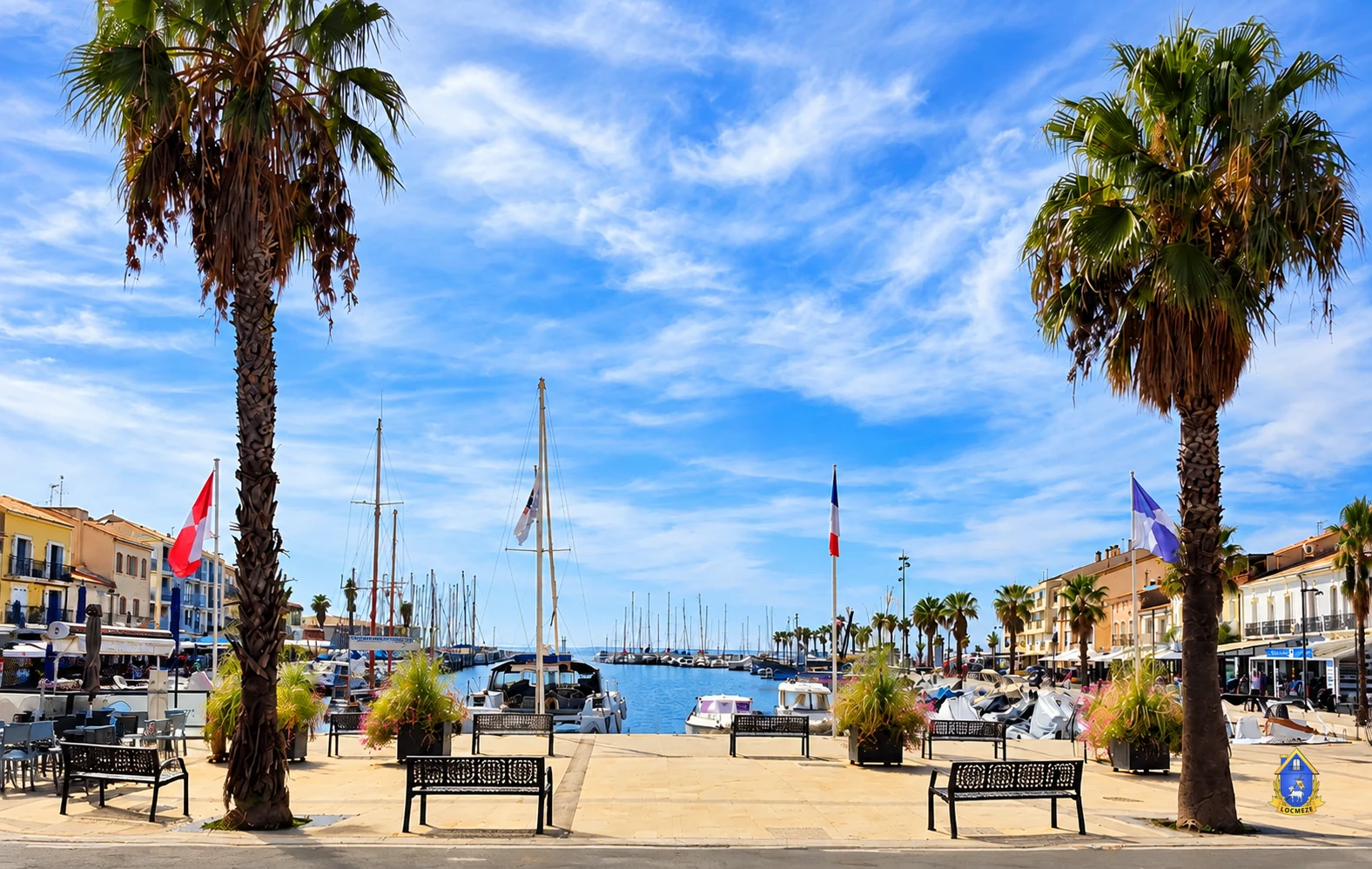
Today, the harbour is mainly devoted to leisure boating, walking, restaurants, water-based activities and tourist boat services across the Thau Lagoon.
This evolution has not, however, erased its role in the identity of the town. Water jousting, historic buildings, the names of the quays, old photographs and the immediate proximity of shellfish-farming activities maintain a permanent link between today’s harbour and its history.
Walking around the harbour therefore takes you through several centuries of history: trade and fishing, barrel makers and steamships, followed by leisure boating and tourism, have all succeeded one another around the same harbour basin.
Continue exploring Mèze
After your walk around Mèze harbour, discover more monuments, beaches, walks and must-see places as you continue exploring Mèze and the Thau Lagoon.
